

The base price is the core starting point of a grid strategy. Below is a detailed explanation with examples.
The base price is the initial reference price for the grid strategy. The system uses the base price as the starting point, combined with the trigger conditions set by the user, to calculate the grid levels above and below the base price, and monitors in real time whether the market price reaches any grid level. When the market price moves up or down and hits a set grid level, that grid boundary becomes the new base price, while the upper and lower boundaries of the original grid shift accordingly to form the new grid range — and the cycle continues from there.
Example—grid trading with a base price of USD 172:
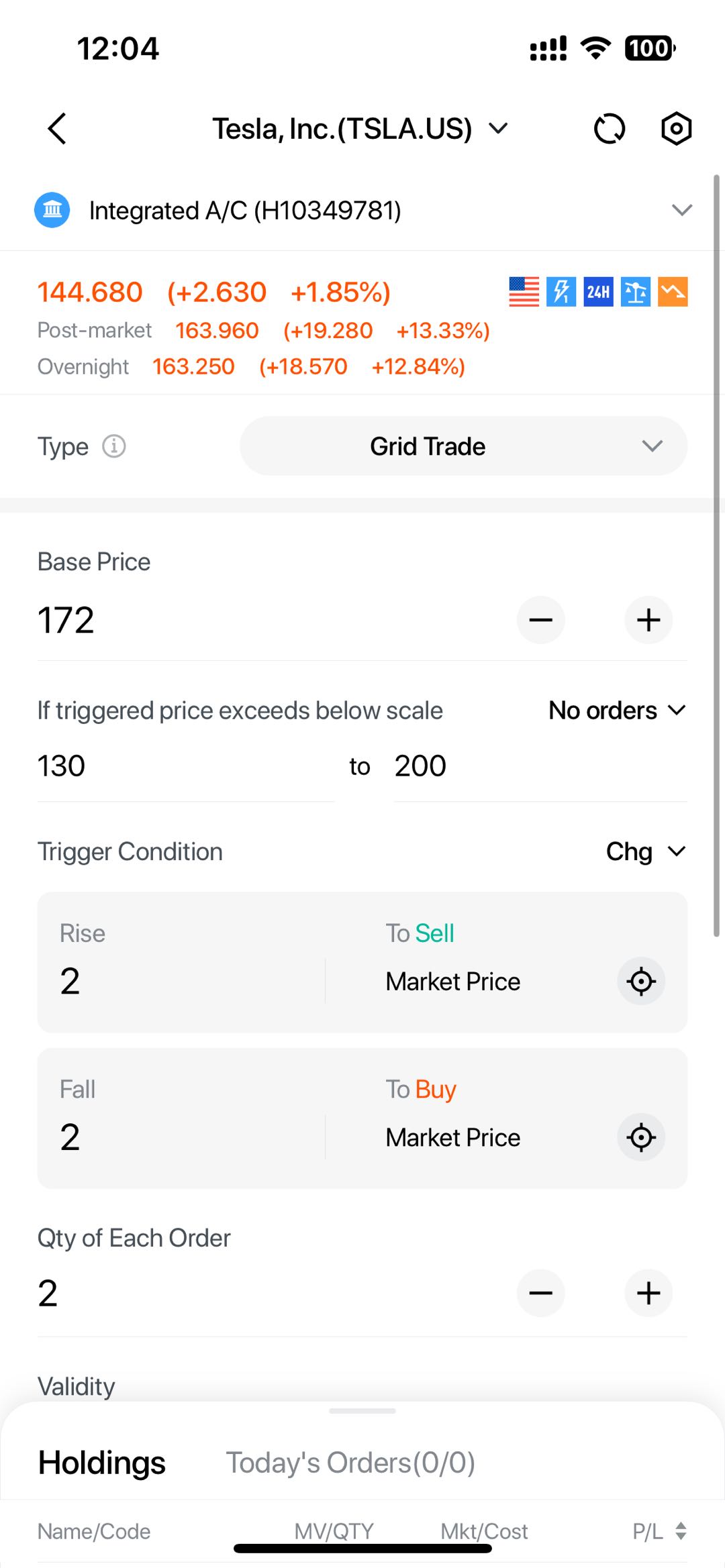
- When the price moves from 172 to 167:
- From 172 to 170: Triggers a buy order of 2 shares of TSLA. The base price is updated from 172 to 170.
- From 170 to 168: Triggers another buy order of 2 shares of TSLA. The base price is updated from 170 to 168.
- From 168 to 167: No buy order is triggered.
- When the price moves from 167 to 170:
- From 167 to 170: Triggers a sell order of 2 shares of TSLA. The base price is updated from 168 to 170.
Key takeaways:
- Role of the base price: Serves as the initial starting point for calculating and generating grids for pending buy and sell orders.
- Dynamic adjustment rules: After each triggered trading, the trigger price becomes the new base price, and subsequent grids are recalculated accordingly.
- Trigger mechanism: Trading is triggered only when the market price touches a grid level; no operation will be performed otherwise.
Disclosures
This article is for reference only and does not constitute any investment advice.
- Business / KOL Partnership
- nz@longbridge.global
- Public Relations
- nz@longbridge.global
- Terms and Conditions
- Customer Agreement
- Privacy Policy
- Risk Disclosure
- Disclaimer
- Disclosure Statement

A New Zealand registered Financial Service Provider (FSP number: FSP600050), and is a member of the Financial Dispute Resolution Scheme, a New Zealand independent dispute resolution service provider.

A licensed corporation recognized by the SFC (CE No. BPX066). Holder of License Types 1 (Dealing in Securities), 2 (Dealing in Futures Contracts), 4 (Advising on Securities) and 9 (Asset Management). Also a registered HKEX participant and HKSCC participant.

Registered with the Monetary Authority of Singapore (MAS), Long Bridge Securities Pte. Ltd. is a Capital Markets Services Licence holder and Exempt Financial Adviser (Licence No. CMS101211).

A broker dealer registered with the Securities and Exchange Commission (SEC)(CRD: 314519/SEC: 8-70711), a member of the Financial Industry Regulatory Authority (FINRA) and Securities Investor Protection Corporation (SIPC).